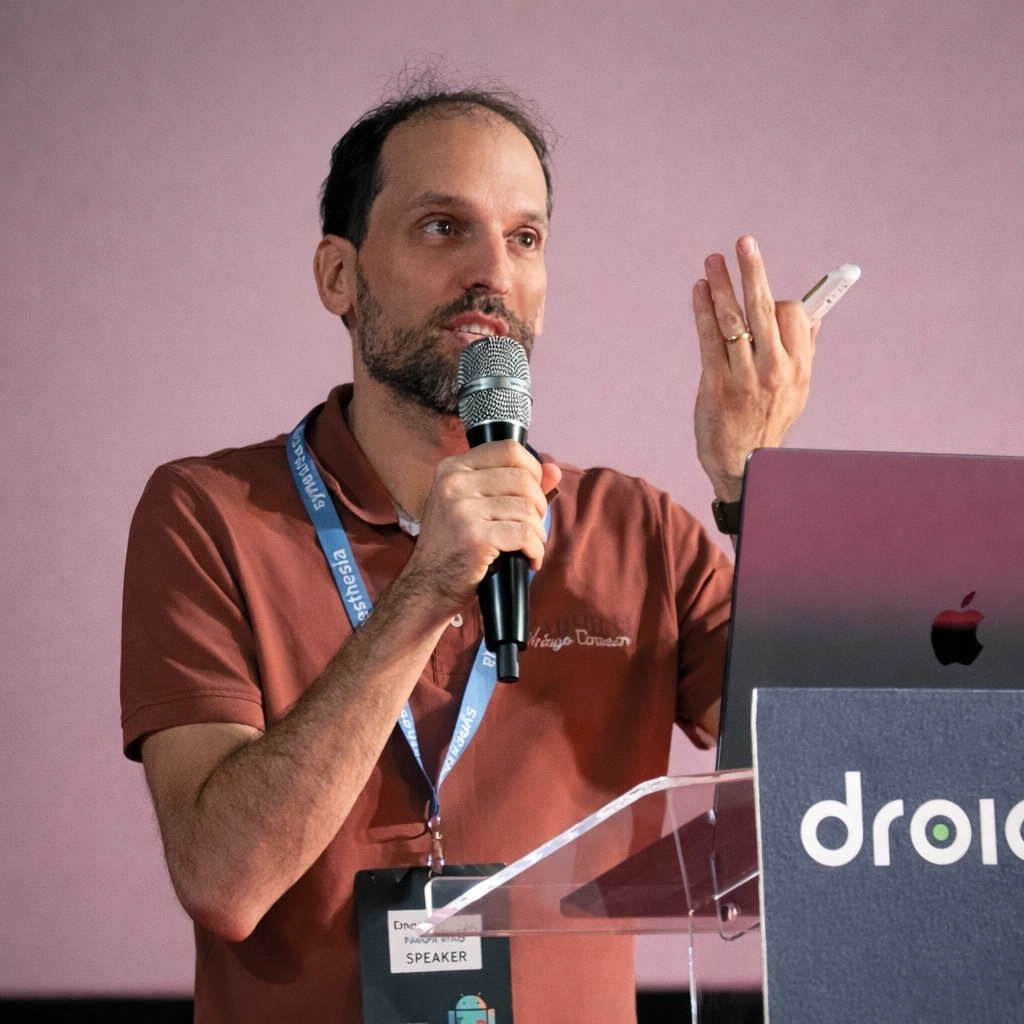
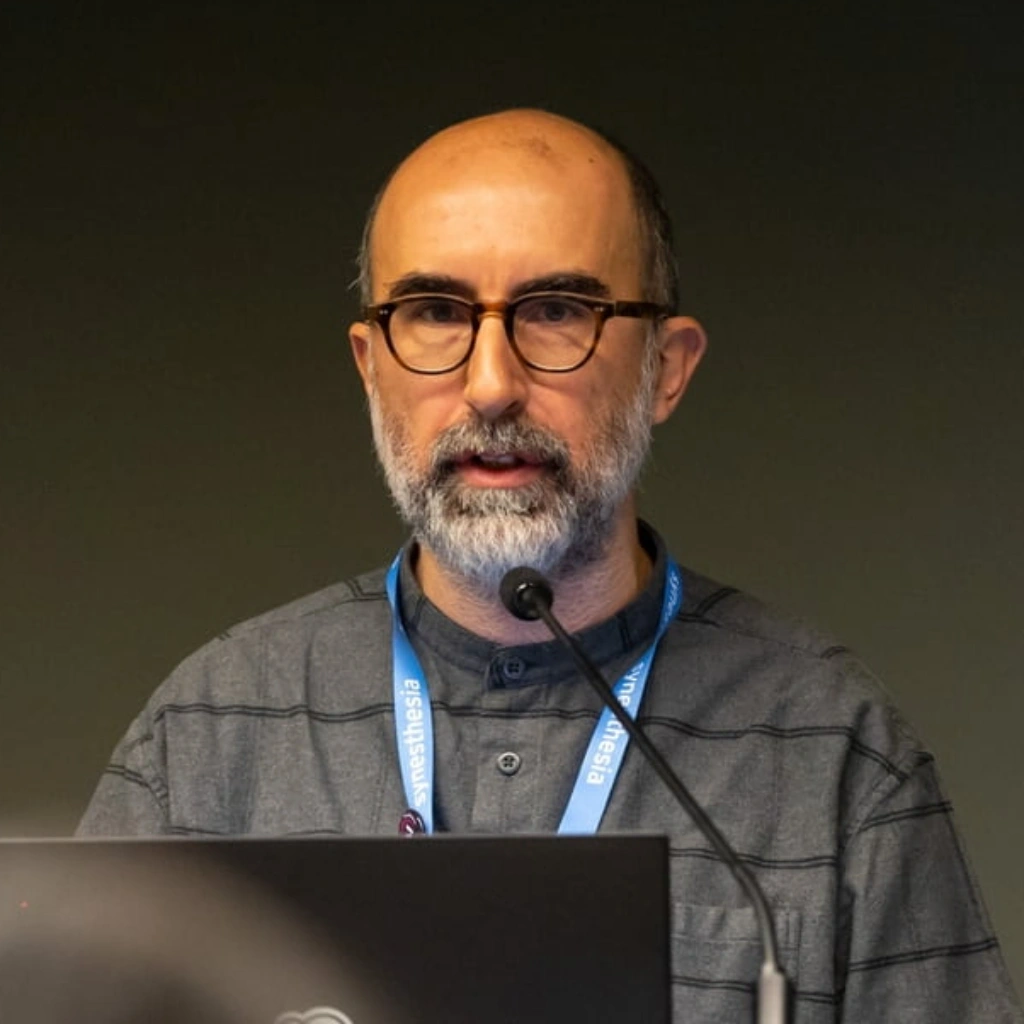
Peter Friese – Staff Developer Relations Engineer – Google
The way we build software has changed. Today, the most successful developers aren’t just writing code, they are orchestrating AI tools and agents to build better and faster. This hands-on session is a deep dive into this modern “Builder Stack”, where you will learn how to build with a variety of tools in the Google ecosystem.
Come to this session if you want to spend less time configuring and more time creating. We’ll guide you through a complete development lifecycle, from prototyping an idea, to generating a beautiful UI, building AI features, and integrating a secure, scalable backend.
Peter Friese
Peter is a Staff Developer Advocate on the Firebase at Google, helping developers build amazing experiences and high quality apps using Firebase and AI.
With a passion for empowering developers and fostering innovation, Peter works tirelessly with the Firebase team to make his vision of “cutting short the time to magic” a reality.
Peter is also the author of the book Asynchronous Programming with SwiftUI and Combine: Functional Programming to Build UIs on Apple Platforms and host of the YouTube show Firebase After Hours, in which he and his colleagues explore Firebase in a light-hearted and fun setting.
He has written code in BASIC, C, ObjectPascal, Java, Kotlin, Xtext, JavaScript, TypeScript, Objective-C, and a number of home-grown DSLs – but his all-time favourite is Swift.
1:00 pm
Break
Lunch Break
2.00 pm
Talk
Superpowered SDLC: The Rise of the Agentic End-to-End Engineering Team
Alberto Roli – Sara Locatelli – Francesco Marchesini – DOCEBO
The traditional software development lifecycle is undergoing a seismic shift. For years, the industry goal has been to transition from siloed, “standard” engineering teams to autonomous End-to-End (E2E) teams that own their products from inception to production. Today, the introduction of advanced AI tooling is forcing an entirely new evolution: **the leap to the Agentic E2E Engineering Team**.
We will explore what it means to build, run, and scale an engineering team where AI is not just a coding assistant, but an active, integrated agent across the entire SDLC. We will map out the evolutionary journey of engineering teams and provide a practical blueprint for supercharging your team’s workflows using AI capabilities.
We will break down how to effectively empower your engineers with AI tools at every critical juncture of the software lifecycle, moving from manual drudgery to high-leverage strategic engineering.
#### Key Areas of Focus Will Include:
—
* **The Evolution of the Engineering Team:** Understanding the paradigm shift from Standard -> E2E -> Agentic E2E teams. * **AI-Driven Tech Specs:** How to leverage LLMs to move from vague product requirements to robust, clearly defined technical specifications and architectural designs. * **Accelerated Development & MRs:** Moving beyond standard autocomplete. We’ll look at agentic coding workflows, and AI-assisted Merge Request (MR) creation. * **Intelligent Code Reviews:** Utilizing AI to automate security checks, enforce coding standards, and provide contextual feedback before human eyes ever see the code. * **Pipeline & Deployment:** Integrating AI to optimize CI/CD pipelines, predict deployment risks, and automate release notes. * **Observability & The Iteration Cycle:** Empowering teams with AI tools for rapid defect triage, log analysis, root-cause identification, and generating automated improvement cycles.
.
Alberto Roli
Alberto Roli is a seasonedSenior Engineering Managerwith over 20 years of experience in the Software Development Life Cycle and the evolution of SaaS and PaaS products. Currently leading the Application Platform team atDocebo, he specializes in transforming engineering groups into high-performing teams. Alberto is an expert in aligning technical strategy with business needs, having successfully engineered global serverless solutions and modernized legacy systems into scalable, event-driven architectures.
Beyond his leadership in the office, Alberto is deeply passionate aboutPlatform Engineering cultureand its power to drive company-wide collaboration. He advocates for a “E2E team” approach, where engineers maintain complete ownership of the service lifecycle—from Infrastructure as Code to automated CI/CD pipelines—to boost both speed and team motivation. His technical interests span acrossCloud Services, Serverless, and Observability, often usingdata-driven strategiesto achieve massive performance gains.
Alberto is speaking atAI Heroesto share his experience in leveraging theE2E team approachin SDLC and superpowering it with AI agents. A casual speaker at events likeServerlessDaysandCodemotion, he enjoys breaking down complex architectural challenges into actionable insights. He aims to show how AI in a strong platform foundation and an observability-first mindset are essential for scaling the next generation ofagentic E2E teams.
2.40 pm
Talk
The Labeling Paradox: How AI is degrading your perception models
Matteo Barale – CIO – Tecnocad Group
Everyone is automating their labeling pipeline with AI. It seems like the obvious move — faster, cheaper, scalable. At Tecnocad, we did it too. Since December 2025, AI handles 70% of the annotation work for our autonomous perception models. And our model quality dropped significantly.
This talk is the honest account of what happened, why it happened, and what we are doing about it.
Building perception systems for real autonomous vehicles is a fundamentally different challenge from building software that assists humans. You cannot afford hallucinations. Edge cases — the rare, unexpected scenarios that matter most for safety — are exactly what AI labeling gets wrong. We will explain why real-world data acquisition, not synthetic simulation alone, remains irreplaceable for physical AI, and how the quality of your training set is the true performance ceiling of your model.
We will close with our forward-looking bets: the case for a European open data lake for autonomous mobility, and the role of VLMs optimized for reality check.
Matteo Barale
Matteo Barale is CIO of Tecnocad, a Turin-based engineering company. He leads TC Autonomous — Tecnocad’s division building Level 4 autonomous vehicles such as ADone, the first robotaxi made in Italy. He oversees AI model development across the full perception-to-deployment pipeline, and participates in the European Commission’s ECAVA working group defining standards for autonomous mobility in European cities.
3.20 pm
Talk
AI Agents as Interviewers: A New Way of Building Specs
Coding agents are very effective when they are given relevant, well-defined specs. But give an agent a vague brief and it will not stop to ask questions. Instead, it will fill in the gaps, **guessing** who the product serves and which trade-offs are acceptable. Inevitably, the result encodes the wrong assumptions.
This talk presents a method to **resolve uncertainties** before writing effective specs.
We introduce the idea of **AI agents as interviewers**: using LLMs to iteratively probe the engineer on relevant product decisions and technical trade-offs. We will walk through four levels of interview prompts, ending with a **reusable skill** that asks one question at a time, offers alternatives, recommends one with its trade-offs, and records every decision in durable repository memory made up of several specialized components: an AGENTS.md guide, a product file, a design file, a domain glossary, and short architecture decision records.
Using a realistic application, we will test each level of interviewing prompt and compare the differences. We will conclude by showing that we do not need to create this kind of skill from scratch: the same pattern appears in **GitHub Spec Kit, Matt Pocock’s grill-with-docs, and Compound Engineering**.
The audience will leave with a new way to use coding agents, along with practical assets they can try on your next project.
Emanuele Fabiani
Emanuele is an entrepreneur, engineer, and researcher passionate about achieving impact with AI.
After earning his PhD in machine learning and working as a guest researcher at EPFL in Lausanne, he is now co-founder and Head of AI at xtream, a company that applies AI to solve complex business challenges. xtream was acquired by TeamSystem in September 2025.
Emanuele is also a professor of AI at the Catholic University of Milan and has been a guest lecturer at Italian, Swiss, and Polish universities.
He has published 8 papers in international journals with 175+ citations and contributed to over 30 international conferences, including AMLD Lausanne, ODSC London, WeAreDevelopers Berlin, PyData Berlin, PyData Paris, PyCon Italy, the Swiss Python Summit, and Codemotion Milan and Rome.
Teaching AI to Read Latin: Structured multi-agent pipeline for complex linguistic analysis
Emmanuele Villa – Senior Technical Consultant – Fincons Group
Complex linguistic tasks require structured systems to handle ambiguity, context, and grammatical analysis.
We present a Kotlin Multiplatform client-server application for web and mobile that performs Latin text analysis, powered by a multi-agent LLM pipeline executing lexical expansion, contextual disambiguation, grammatical annotation, error detection, and corrective feedback.
The server orchestrates a series of specialized agents: – Lexical Agent: generates all plausible lemmas and meanings for each token; – Translation Agent: disambiguates meanings using context; – Grammar Agent: selects correct morphological forms; – Critic Agent: identifies potential errors and ambiguities; – Correction Agent: finalizes annotations with notes and confidence scores;
Attendees will learn how to implement LLM systems that combine semantic reasoning, linguistic expertise, and agent-based self-critique, all within a Ktor client-server architecture that processes Latin texts on demand.
Emmanuele Villa
Emmanuele Villa is a Senior Technical Consultant at Fincons Group, leading mobile and web development with technologies like Kotlin Multiplatform, Compose, and SwiftUI.
He also teaches at the Università della Terza Età in Carate Brianza and is pursuing a degree in History, bridging his passion for technology and the humanities.
Outside of work, he enjoys exploring Quantum Computing, running dungeons&dragons, and reading One Piece.
4.40 pm
Talk – Will be announced soon
5.20 pm
Talk
Building an Early-Stage Startup: AI That Actually Works and What Investors Fund
Marcello Domenis – CoFounder & CTO – Clev
The zero to one phase of an AI startup is where most projects quietly fail. Not because the models are weak, but because the problem is wrong, the scope is off, the team is misbuilt, and execution drifts away from real customer value.
This talk presents a practical zero to one playbook for developers and technical leaders who want to move from builder to founder in the AI era. It connects three elements that are usually treated separately: early product execution, early team design, and what investors actually fund at pre seed and seed stage.
You will learn how to choose a problem customers will pay to solve, how to turn AI capabilities into a real product wedge instead of a demo, how to run tight design partner loops, how to structure a two to four person early team, which roles to delay, and which concrete signals make investors back early technical teams. The session also highlights common early stage failure patterns, including overengineering, premature scaling, and misaligned hires.
Marcello Domenis
Marcello is a CTO and founder building AI and computer graphics systems for construction and building design, focused on deploying AI in real production workflows and turning deep tech into usable products.
He previously bootstrapped an AI agent platform to hundreds of users and worked at Sanctuary AI on spatial intelligence for humanoid robots. He is now CTO and co-founder of Clev, where he leads AI-driven design automation used by architecture and engineering firms with over €40M in combined annual revenue. The company secured early backing from an international VC-backed accelerator and multiple European co-design partners.
He operates across North America and Europe and brings a combined perspective of venture capital, early stage startup execution, and hands-on engineering. His speaking topics include cloud and AI deployment, early adoption in production, and building technical startups from zero to traction.
Edge Intelligence: Building with Apple Foundation Models on iOS
Tomas Parizek – Senior iOS Engineer – STRV
Defaulting to cloud APIs is no longer the only way to ship AI in iOS apps. This hands-on workshop dives into Apple Foundation Models, moving past theory to build privacy-first AI features directly into native apps.
We will focus on practical implementation: how to actually run these models, customize them for your specific domain, and empower them by providing external tools to enrich context and build truly smart, localized experiences. Requirements: MacBook, Apple Intelligence-compatible iPhone, and basic Swift/Xcode skills.
Tomas Parizek
I’m Tomáš, a Prague-based developer with over 10 years of experience turning code into products. I’m a Senior iOS Engineer at STRV and I explore the bleeding edge of Agentic AI, pushing the limits of what a single developer can ship using autonomous tools. I’m obsessed with moving beyond “vibe coding” to find practical, scalable ways to integrate AI into mobile development lifecycle.
11:00 am
Workshop
From dream to reality: how Claude Code supports video game development
Marco Mazzaglia – Video Game Evangelist – Tiny Bull Studios
The usage of Artificial Intelligence in video game production has immediately sparked controversy linked to the notion of ‘AI sloppiness’ and the risk of undermining the entire creative process.
The workshop, however, aims to demonstrate in practical terms how Artificial Intelligence can be used to streamline prototyping and the range of complex tasks involved in product development. Starting with the use of Claude Code and related tools, the workshop aims to give the audience a hands-on experience of the practical benefits of using AI in this field.
Marco Mazzaglia
Holding a Master’s degree in Computer Science (Specialised Programming Languages and Artificial Intelligence), Marco Mazzaglia has built a robust career in mass-market video game development, contributing to over 30 B2C titles for PC and consoles since the sixth hardware generation. He has worked with leading Italian studios such as Milestone, Memorable Games (MixedBag), and 34BigThings, gaining deep expertise in international consumer market dynamics. Today, he serves as Business Developer and Video Game Evangelist at Tiny Bull Studios, managing strategic projects like the narrative adventure The Lonesome Guild for publisher DON’T NOD, alongside B2B initiatives such as Foodland. This industrial expertise forms the foundation of his academic work as Adjunct Professor in “Game Design and Game Thinking” at the Politecnico di Torino, where he trains future engineers on professional production processes.
12:00 pm
Workshop
Mastering AI-Driven Development with Gemini CLI Conductor
Rosário P. Fernandes – Developer Relations Engineer – Google
Developers are increasingly looking for ways to leverage LLMs not just as chat interfaces, but as integrated partners in the software development lifecycle. **Gemini CLI Conductor** represents a shift toward this “agentic” workflow, allowing developers to plan, implement, and iterate on full-stack applications through a unified, AI-native interface.
This hands-on workshop takes participants through the lifecycle of a modern application using the Gemini CLI Conductor extension. We will dive into:
* **Greenfield Development:** Building a “Picker Wheel” web application from scratch, moving from initial concept to a functional UI using AI-driven planning. * **Brownfield Iteration:** Learning how to refine an existing codebase by adding complex features like authentication and persistent storage. * **Firebase Integration:** Demonstrating how to seamlessly inject backend services into an AI-generated frontend to create a personalized user experience.
### Key Takeaways
* **AI Orchestration:** Understand how to use the Conductor extension to manage multi-step coding tasks that go beyond simple code completion. * **Iterative Prompting:** Master the art of “planning-first” development, where the AI helps architect the solution before a single line of code is written. * **Full-Stack Agility:** Learn how to rapidly prototype and harden applications by combining the power of Gemini with established platforms like Firebase and Node.js.
Rosário P. Fernandes
Rosário P. Fernandes (@thatfiredev) is a Developer Relations Engineer on the Firebase team at Google, focused on helping developers integrate Firebase and Generative AI into their mobile apps. With a passion for developer communities, he can often be found hanging out with other Android, Firebase, or Flutter developers. In his free-time, he enjoys playing videogames, reading comic books and watching movies.
1:00 pm
Break
Lunch Break
2.00 pm
Talk
From Retrieval to Coverage: Rethinking RAG for the Long Tail
Sina Famouri – CTO – Luxia
The zero to one phase of an AI startup is where most projects quietly fail. Not because the models are weak, but because the problem is wrong, the scope is off, the team is misbuilt, and execution drifts away from real customer value. This talk presents a practical zero to one playbook for developers and technical leaders who want to move from builder to founder in the AI era. It connects three elements that are usually treated separately: early product execution, early team design, and what investors actually fund at pre seed and seed stage. You will learn how to choose a problem customers will pay to solve, how to turn AI capabilities into a real product wedge instead of a demo, how to run tight design partner loops, how to structure a two to four person early team, which roles to delay, and which concrete signals make investors back early technical teams. The session also highlights common early stage failure patterns, including overengineering, premature scaling, and misaligned hires.
Sina Famouri
Sina Famouri is the CTO and co-founder of Luxia and an adjunct professor at the Open Institute of Technology (OPIT). His work spans both academia and industry, with a focus on building AI systems for real-world applications.
He began his career in machine learning research during a period when classical methods dominated, and has since worked across the evolution of the field—from early deep learning approaches to modern AI systems. His background includes AI in medicine and computer vision for medical imaging, along with experience in building practical, production-ready solutions.
He brings a broad perspective on AI, combining strong theoretical foundations with hands-on experience in developing systems that operate in complex, real-world environments.
2.40 pm
Talk
Build smarter mobile & web apps: integrate Gemini using Firebase AI Logic
Rosário P. Fernandes – Developer Relations Engineer – Google
As demand for intelligent features in mobile and web applications grows, developers face the challenge of securely integrating generative AI models without overcomplicating their backend infrastructure. In this session, we will explore Firebase AI Logic, a tool that gives you direct access to Google’s Gemini models through client-side SDKs.
We will dive into how Firebase AI Logic simplifies the implementation path for Android, Flutter, iOS and Web developers, allowing you to build features like multimodal chat, image generation, structured data output, live audio conversations, and hybrid inference entirely in the client-side.
**Key takeaways include:**
* **Client-Side simplicity:** How to use platform-specific SDKs to call Gemini APIs without managing a custom backend. * **Security Best Practices:** Utilizing **Firebase App Check** to protect your API keys and prevent abuse from unauthorized clients. * **Advanced Capabilities:** A look at leveraging multimodal inputs (text, images, audio, PDF), function calling, structured JSON outputs, voice interactions and hybrid on-device/cloud inference. * **Production Readiness:** Tips for updating model parameters dynamically and monitoring usage to stay within quotas.
Rosário P. Fernandes
Rosário P. Fernandes (@thatfiredev) is a Developer Relations Engineer on the Firebase team at Google, focused on helping developers integrate Firebase and Generative AI into their mobile apps. With a passion for developer communities, he can often be found hanging out with other Android, Firebase, or Flutter developers. In his free-time, he enjoys playing videogames, reading comic books and watching movies.
3.20 pm
Talk
Beyond Vibe Coding: Architecting the Future of Mobile Apps with AI Agents
Tomas Parizek – Senior iOS Engineer – STRV
The definition of “Mobile Engineering” is shifting. As we enter the Agentic Era, the bottleneck is no longer writing syntax – it’s architecture, governance, and verification.
This session is for developers and leaders ready to upgrade their mental models and their tech stacks. We will examine real-world “Agentic Patterns” that allow small mobile teams to ship with the velocity of giants.
Tomas Parizek
I’m Tomáš, a Prague-based developer with over 10 years of experience turning code into products. I’m a Senior iOS Engineer at STRV and I explore the bleeding edge of Agentic AI, pushing the limits of what a single developer can ship using autonomous tools. I’m obsessed with moving beyond “vibe coding” to find practical, scalable ways to integrate AI into mobile development lifecycle.
Language Games and LLMs: What Wittgenstein Can Teach Us
Jiri Koutny – Engineering Manager – STRV
LLMs don’t fail because they “lack intelligence.” They fail because we keep asking them to play games whose rules we never wrote down. Wittgenstein’s idea of language games offers a sharper mental model: meaning doesn’t live in definitions, but in use—and use is governed by shared practices, context, and what counts as a correct move.
This talk treats prompts, tools, and RAG as the rulebook that turns fluent text into dependable behavior. Instead of “better prompts,” we focus on clearer games: intent, constraints, allowed moves, and explicit output contracts. We’ll explore why hallucinations and prompt drift are often not “bugs” in the model, but mismatches between the game we think we’re playing and the one we actually set up—and how lightweight, rule-based evaluations can catch that gap before production does.
Jiri Koutny
Jiří Koutný is an Engineering Manager at STRV with a Ph.D. in computer science and 20+ years of experience building backend and platform systems and leading teams to deliver business-critical software.He specializes in translating complex technical challenges into scalable architectures, clear roadmaps, and high-impact delivery—while growing strong, autonomous engineering teams.
Jiří also teaches and lectures at Czech universities, connecting foundational computer science with real-world engineering practice.  At AI Heroes, he’s speaking to help teams ship LLM-powered products more reliably by bringing a pragmatic engineering lens to how we design, ground, and evaluate language-model systems in production.
Vibe coding has brought app development to everyone — but is it adequate for professional-level work? And what happens when you move beyond the vibe, into more structured, agentic approaches?
We’ll walk through the spectrum of AI-assisted development, from free-form generation to spec-driven workflows, with a clear goal in mind: understanding what it takes to produce enterprise-grade software with agentic tools.
Along the way we’ll cover predictability and consistency across a codebase, the current limits of today’s tools, and the gap between a working prototype and code you’d actually ship.
Marco De Nittis
Freelance consultant, trainer and technology enthusiast with a deep love for every layer of product life — from architecture and DevOps to actual coding.
He has worked with both large enterprises and smaller companies, contributing to a wide variety of projects across the full software lifecycle.
Involved in building GenAI solutions — from design to implementation — with a keen interest in the emerging standards and protocols shaping the AI ecosystem, such as MCP, AGUI, A2A, A2UI and the broader agentic landscape.
Pragmatic, eclectic and curious. AI, cloud, serverless and WebAssembly are the spaces where he spends most of his time — as a practitioner, consultant and trainer.
Focused on helping teams to embrace AI-aided software workflow: understanding how to work with AI to write enterprise level software, faster — without losing critical thinking.
He is lucky to have turned one of his passions into a profession.
Teaching AI How You Work: Building Systems That Automate Human Expertise
Enrico Pulvirenti – Senior Android Developer – The Trainline
Here’s the problem with generic AI assistants: a senior engineer asks “How do I deploy this service?” and gets the same tutorial everyone else gets. The AI doesn’t know how YOUR team actually operates – your deployment workflow, your infrastructure decisions, or the lessons you learned when production went down at 3am.
This talk demonstrates how to build AI systems that work the way your experts actually work – encoding the step-by-step processes, decision-making patterns, and operational knowledge that typically live only in senior developers’ heads.
You’ll see working examples of AI systems that mimic how experts operate across different domains – from technical workflows to content creation to cross-team processes. The key isn’t what they automate, but how they capture and reproduce expert methodology.
The Strategic Imperative: Generic AI tools are a commodity – everyone gets the same answers from ChatGPT and Copilot. The competitive advantage comes from AI that knows how YOUR organization operates. This matters when tribal knowledge walks out the door, onboarding takes months, and “how we do things” lives in Slack threads and senior developers’ heads.
Embracing AI means making it personal – encoding your team’s operational expertise into shareable, scalable systems.
Lessons Learned: ✓ When encoding workflows adds value vs. when traditional automation wins ✓ What I over-engineered and regret ✓ Patterns for capturing operational expertise without maintenance nightmares ✓ Real constraints and trade-offs from daily use
Attendees leave with live demonstrations, GitHub repositories, and a framework for deciding when personalized AI systems make sense vs. when generic tools are the right choice.
Enrico Pulvirenti
Enrico Pulvirenti has spent the last decade building Android applications, currently leading Android community initiatives at Trainline as a Senior Android Engineer. His recent focus is on practical AI automation – building systems that capture and reproduce how experts actually operate rather than relying on generic tools. He’s passionate about developer experience, making AI personal, and the honest evaluation of when AI adds value versus when traditional automation wins. Enrico is speaking at AI Heroes to share real lessons learned from building personalized AI systems and to demonstrate that the competitive advantage in AI comes from encoding your team’s expertise, not just using generic tools.
Debunk Your ViewModel Performance in the New AI Era
Arnaud Giuliani – Co-founder – CPTO – Kotzilla
ViewModels are at the heart of modern Android and KMP apps, and they come with hidden performance traps most teams discover too late. Lifecycle mismanagement, scope leaks, bad memory patterns, dependency resolution overhead: these issues are hard to trace in production, and AI-assisted development makes them worse. More code ships faster, abstractions multiply, and ViewModel problems become invisible until users are already impacted.
In this hands-on workshop, we’ll debug real ViewModel performance scenarios together, using Koin and Kotzilla to detect issues at the component level without manual instrumentation. You’ll see how DI-based observability gives AI agents the architectural context they need to go from code generator to diagnostic partner.
Agenda: Intro (10 min) — The ViewModel performance trap: what AI-assisted development changes and why Lab 1 (20 min) — Spot common issues in a sample app: scope leaks, lifecycle mismanagement, resolution overhead Lab 2 (25 min) — Instrument with Koin + Kotzilla: component-level detection, no manual logging Lab 3 (25 min) — Bring AI into the loop: architectural context as a diagnostic lever Wrap-up (10 min) — Patterns to take home, Q&A
Prerequisites: – Kotlin experience (intermediate level minimum) – Familiarity with Android or KMP development – Basic knowledge of ViewModel and Jetpack Lifecycle concepts – Koin or another DI framework used in at least one project – Laptop with Android Studio installed and a working Gradle setup – Sample project provided in advance (GitHub link shared before the event)
Arnaud Giuliani
Arnaud Giuliani is co-founder and CTPO of Kotzilla, and creator of Koin, a dependency injection framework for Kotlin used by millions of developers and 25% of native Android applications worldwide. He has been exploring the intersection of software architecture and developer experience throughout an eighteen-year career, and is a member of the Kotlin Foundation. A seasoned speaker with 50+ talks delivered across Europe and the US since 2016, he recently published “The Next Software Crisis Won’t Be About Writing Code,” tracing thirty years of software engineering crises to argue that architecture and design matter more than ever in the age of AI.
10.30 am
Workshop
From agentic loop to multi-agent system — in Python, from scratch
Samuele Bolotta – Senior AI Engineer – ProfessionAI
Using an agentic framework without understanding what’s underneath is a recipe for incomprehensible bugs in production.
In this hands-on workshop we start from the ground up: we build a ReAct agentic loop from scratch with the OpenAI SDK with nothing hiding the mechanism. Once the pattern is clear, we scale it up: we use LangGraph to orchestrate multiple agents on a real task, managing shared state, handoffs and explicit fallbacks.
In the final section we trace the execution with LangSmith, because a system you can’t observe doesn’t go to production.
Samuele Bolotta
Samuele Bolotta is an AI Consultant and Educator with a background in Artificial Intelligence, Computational Neuroscience and Cognitive Science. He currently works as a Senior AI Engineer at ProfessionAI. Previously a Research Assistant at Mila (Montreal Institute for Learning Algorithms), where he worked on multi-agent reinforcement learning, he has since focused on translating advanced AI concepts into practical, production-ready applications. He holds an Erasmus Mundus M.Sc. in Neuroscience (VU Amsterdam, Harvard, Bordeaux) and an M.Sc. in AI Systems at the University of Trento. Outside of work, he is a competitive powerliting coach — applying the same systematic, evidence-based approach to the platform as he does to building AI systems.
12.00 pm
Workshop
Building AI apps with the Google ecosystem
Peter Friese – Staff Developer Relations Engineer – Google Marina Coelho – Developer Relations Engineers – Google
The way we build software has changed. Today, the most successful developers aren’t just writing code, they are orchestrating AI tools and agents to build better and faster. This hands-on session is a deep dive into this modern “Builder Stack”, where you will learn how to build with a variety of tools in the Google ecosystem.
Come to this session if you want to spend less time configuring and more time creating. We’ll guide you through a complete development lifecycle, from prototyping an idea, to generating a beautiful UI, building AI features, and integrating a secure, scalable backend.
Peter Friese
Peter is a Staff Developer Advocate on the Firebase at Google, helping developers build amazing experiences and high quality apps using Firebase and AI.
With a passion for empowering developers and fostering innovation, Peter works tirelessly with the Firebase team to make his vision of “cutting short the time to magic” a reality.
Peter is also the author of the book Asynchronous Programming with SwiftUI and Combine: Functional Programming to Build UIs on Apple Platforms and host of the YouTube show Firebase After Hours, in which he and his colleagues explore Firebase in a light-hearted and fun setting.
He has written code in BASIC, C, ObjectPascal, Java, Kotlin, Xtext, JavaScript, TypeScript, Objective-C, and a number of home-grown DSLs – but his all-time favourite is Swift.
Marina Coelho
Marina is a Developer Relations Engineer at Google, focused on building native Android apps. Her mission is to help developers excel in building and growing their apps using Firebase, GCP and our suite of AI tools! Before joining the Firebase team in 2022, Marina worked as a software engineer for 8 years, 5 of which were dedicated to Android app development. She loves all things Jetpack Compose, Firebase and AI!
1:00 pm
Break
Lunch Break
2.00 pm
Talk
The Evolution of Coding: Spec-Driven Development in the Age of Agentic AI
Enrico Zimuel – Tech Lead & Principal Software Engineer – Elastic
Agentic AI is redefining coding by shifting the developer’s role from writing every instruction to specifying intent, constraints, and expected outcomes. In this new landscape, Spec-Driven Development becomes essential: specifications guide AI agents in generating, testing, and refining software with greater reliability and control.
This presentation explores how coding is evolving from implementation-centric practice to specification-centered engineering, and why the future of software development depends on designing precise, verifiable specs as the foundation for AI-assisted systems.
Enrico Zimuel
**Enrico Zimuel** is an Adjunct Professor of Artificial Intelligence and Machine Learning at the [University of Turin](https://www.unito.it/), and of Agentic AI and RAG architectures at [University of Roma Tre](https://www.uniroma3.it/). He conducted research at the [University of Amsterdam](https://www.uva.nl/) and has collaborated with Silicon Valley companies for over 15 years. He has been a programmer since 1996 and has developed several open-source projects, such as [Zend Framework](https://framework.zend.com/), with more than 570 million installations, which won the InfoWorld Bossie Award in 2010. He is currently a Tech Lead and Principal Software Engineer at [Elastic](https://www.elastic.co/) (USA), a [TEDx](https://www.youtube.com/watch?v=SienrLY40-w) speaker, and a presenter at more than 140 conferences. He is also the author of several publications, including [Anatomia di una mente artificiale. Fondamenti e promesse dell’intelligenza artificiale](https://www.libroia.it), published in 2026.
2.40 pm
Talk
Agentic coding for mobile developers
Peter Friese – Staff Developer Relations Engineer – Google
Software engineering has changed dramatically. In just a few months, we’ve gone from AI-assisted code completion to fully autonomous coding agents that can build entire applications from simple prompts.
*Or can they?*
In this talk, I am going to explain what coding agents are, how they work, and how you can use them most efficiently for your work.
You will learn
– How coding agents work (inner / outer loop) – The role of AGENTS.md – What skills are, and why they are essential for coding agents – The importance of writing a clear specification – How to use all of this in your own projects
Throughout the talk, I will demonstrate the key concepts by vibe-engineering a food-ordering app, backed by Firebase. You will walk away with a concrete recipe for using agentic coding in your own projects.
Peter Friese
Peter is a Staff Developer Advocate on the Firebase at Google, helping developers build amazing experiences and high quality apps using Firebase and AI.
With a passion for empowering developers and fostering innovation, Peter works tirelessly with the Firebase team to make his vision of “cutting short the time to magic” a reality.
Peter is also the author of the book Asynchronous Programming with SwiftUI and Combine: Functional Programming to Build UIs on Apple Platforms and host of the YouTube show Firebase After Hours, in which he and his colleagues explore Firebase in a light-hearted and fun setting.
He has written code in BASIC, C, ObjectPascal, Java, Kotlin, Xtext, JavaScript, TypeScript, Objective-C, and a number of home-grown DSLs – but his all-time favourite is Swift.
3.20 pm
Talk
An AI assistant for a mid-sized public institution
Mattia Ropelato – CPO– Luxia
This case study describes the development of an AI assistant for a mid-sized public institution, built on two distinct document corpora converging into a single knowledge graph. The project tackles two parallel pipelines: a structured MediaWiki corpus that is not natively AI-ready, and a GLPI ticketing system with over 15,000 raw tickets. In the first case, value is not created from scratch by AI — it emerges from the curation work already done by operators, where categories, tags, and cross-references become the graph itself. In the second, AI compresses the noise into 119 canonical Knowledge Units: intermediate structures that aggregate redundant tickets and distill each one into problem statement, probable cause, solution steps, and applicability conditions. The end result is an assistant capable of answering operational queries by citing real sources, building responses on top of dozens of deduplicated tickets. The presentation argues that the technical challenge — dimensionality reduction, semantic extraction, clustering — is only a means to an end: the real work is the cultural shift in how institutions produce and maintain documentation. The knowledge graph is not a separate infrastructure layer. It is the existing human work, made traversable by a machine.
Mattia Ropelato
I hold an academic background in Political Science from the University of Trento. My career began in educational and social services, where I focused on issues of marginalization and social distress — an experience that broadened my perspective before drawing me back to my original passion: computer science. At PRT Group, I played a key role in designing and building the data analytics infrastructure. I then joined Luxia as Chief Product Officer, where I lead product strategy and the development of AI-powered solutions aimed at making data and institutional knowledge accessible to everyone — including the knowledge graph project presented in this case study. My work is driven by a consistent thread: using technology to solve complex, real-world problems and create meaningful impact.
4.00 pm
Talk
Leveraging on-device AI to enhance the user’s experience
Firas Safa – Senior iOS Engineer – GetYourGuide
On-device AI is finally becoming usable for everyday mobile development on iOS and Android. Instead of treating it like magic, this talk takes a practical look at what it actually means to run intelligence locally on a user’s device. We will walk through how to get started on both platforms, what the current tooling looks like, where things work well, and where the real limitations still are.
From there, we shift into the product and UX side of the conversation. Running models on-device opens the door to a new class of user experience improvements, but only if they are integrated thoughtfully into real user flows. We will discuss how to think about these opportunities, what makes an AI enhancement genuinely useful, and how to avoid adding clever features that do not meaningfully help users.
We will go some real life examples and scenarios where we leveraged on-device AI to provide the end user with a better experience all around.
A big part of the challenge is trust. AI systems are probabilistic by nature, which means you are often shipping behavior that is not correct one hundred percent of the time. We will cover practical ways to test these systems, design appropriate guardrails, and roll out features responsibly so users stay confident in what your app is doing.
The goal of this session is to give teams a clear, realistic view of the on-device AI landscape on mobile today, along with concrete guidance for turning the technology into user experiences that feel fast, helpful, and dependable in the real world.
Firas Safa
Firas is a iOS Engineer with over a decade of experience building and evolving complex mobile systems at scale. Currently based in Zurich, he focuses on architecture, platform modernization, and helping teams ship reliable products in demanding environments. His work has spanned fintech and mobility, where correctness, performance, and long term maintainability matter far more than surface level polish.
Born in Lebanon and raised largely in Italy, Firas brings a pragmatic, systems first mindset to mobile engineering. He is particularly interested in how thoughtful architecture and strong technical foundations enable better products and faster teams over time. While he cares about good user experiences, his day to day work lives much closer to the core of the stack: untangling legacy code, designing client architectures, and making mobile platforms easier to build on.
He is also a regular conference speaker who enjoys sharing honest lessons from the field, especially around UX, design systems, scaling mobile codebases and introducing new technologies safely. Outside of engineering, he performs stand up comedy, where he applies the same instincts for timing, structure, and audience awareness that serve him well in technical leadership.
4.40 pm
Talk
The Next Software Crisis Won’t Be About Writing Code
Arnaud Giuliani – Co-founder – CPTO – Kotzilla
AI generates code faster than ever. But thirty years of software engineering crises tell us the same story: every time we confuse producing with building, we lose meaning. And every time, a movement brings it back.
Agile restored the why (building software for people whose needs change). Craftsmanship and XP restored the how (TDD, clean code, the discipline behind quality). DDD and Clean Architecture restored the what (modeling the business domain, not just stacking features). Each time, the industry rediscovered that the real value of our craft lies beyond code production.
Today, AI is pushing us toward a new crisis. Not technical, but architectural. When code is nearly free, “good enough” becomes invisible, and technical debt compounds at the speed of light.
Drawing from 18 years of building software, creating Koin (used by 25% of native Android apps), and running Kotzilla (where we both build with AI and build tools for engineers navigating the same challenge), I’ll show why architecture and domain modeling have never mattered more. Then I’ll get practical: how do you leverage architectural context to drive development in the AI era? Using dependency injection as a concrete example, I’ll show how making your architecture observable gives both developers and AI agents the context they need to make decisions that hold up over time.
Arnaud Giuliani
Arnaud Giuliani is co-founder and CTPO of Kotzilla, and creator of Koin, a dependency injection framework for Kotlin used by millions of developers and 25% of native Android applications worldwide. He has been exploring the intersection of software architecture and developer experience throughout an eighteen-year career, and is a member of the Kotlin Foundation. A seasoned speaker with 50+ talks delivered across Europe and the US since 2016, he recently published “The Next Software Crisis Won’t Be About Writing Code,” tracing thirty years of software engineering crises to argue that architecture and design matter more than ever in the age of AI.
5.20 pm
Talk
Self-Improving Agents without Self-Destruction
Benedetto Manasseri – Lead AI Engineer – Datapizza
Every AI system starts drifting from reality the moment real users touch it.
The question is never whether you’ll need to improve it (you will), but how you turn real usage and feedback into improvement you can actually trust, instead of educated guessing.
And it all comes down to one thing: evals-driven development. Without it, “we made it better” is just a feeling.
Evaluation and a tight feedback loop are a strong place to start. But can we push further, and stay in control of what happens?
Today you’ll watch a genuinely self-improving system at work: using meta-prompting, it turns real user feedback into improvement proposals, scores each against a curated evaluation set, and keeps only the one that measurably wins.
Humans are always in the loop: without their approval, nothing ships.
Built on datapizza-ai, our open-source framework for GenAI applications.
Benedetto Manasseri
Benedetto Manasseri is a Computer Science graduate from Politecnico di Torino (Data Science & AI track). Currently, he is Lead AI Engineer at Datapizza and he works on several complex GenAI projects (RAG-based chatbots, Agents for business processes automation, AI-native platforms).
Datapizza is an AI Transformation company that helps businesses and institutions turn Artificial Intelligence from experimentation into a stable operational capability. Rather than building isolated demos or shallow integrations, Datapizza designs systems, builds expertise, and embeds AI into real-world processes.
6:00 pm
Networking
Networking Aperitif & Community Building
Included in all tickets
Manage Consent
To provide the best experiences, we use technologies like cookies to store and/or access device information. Consenting to these technologies will allow us to process data such as browsing behavior or unique IDs on this site. Not consenting or withdrawing consent, may adversely affect certain features and functions.
Functional
Always active
The technical storage or access is strictly necessary for the legitimate purpose of enabling the use of a specific service explicitly requested by the subscriber or user, or for the sole purpose of carrying out the transmission of a communication over an electronic communications network.
Preferences
The technical storage or access is necessary for the legitimate purpose of storing preferences that are not requested by the subscriber or user.
Statistics
The technical storage or access that is used exclusively for statistical purposes.The technical storage or access that is used exclusively for anonymous statistical purposes. Without a subpoena, voluntary compliance on the part of your Internet Service Provider, or additional records from a third party, information stored or retrieved for this purpose alone cannot usually be used to identify you.
Marketing
The technical storage or access is required to create user profiles to send advertising, or to track the user on a website or across several websites for similar marketing purposes.